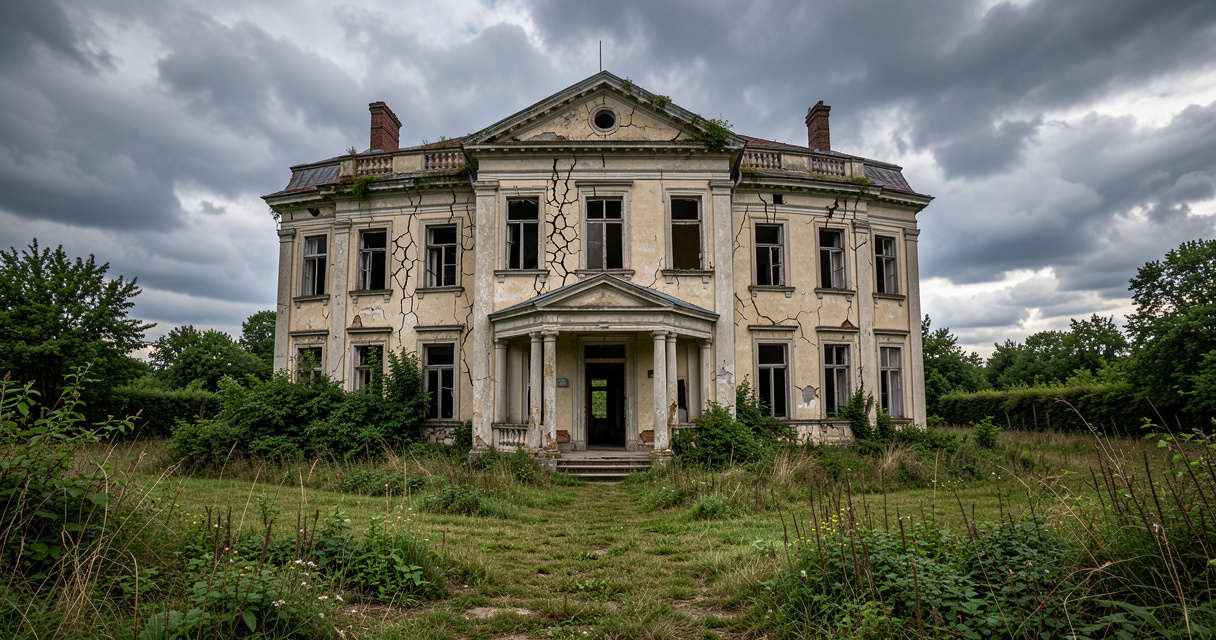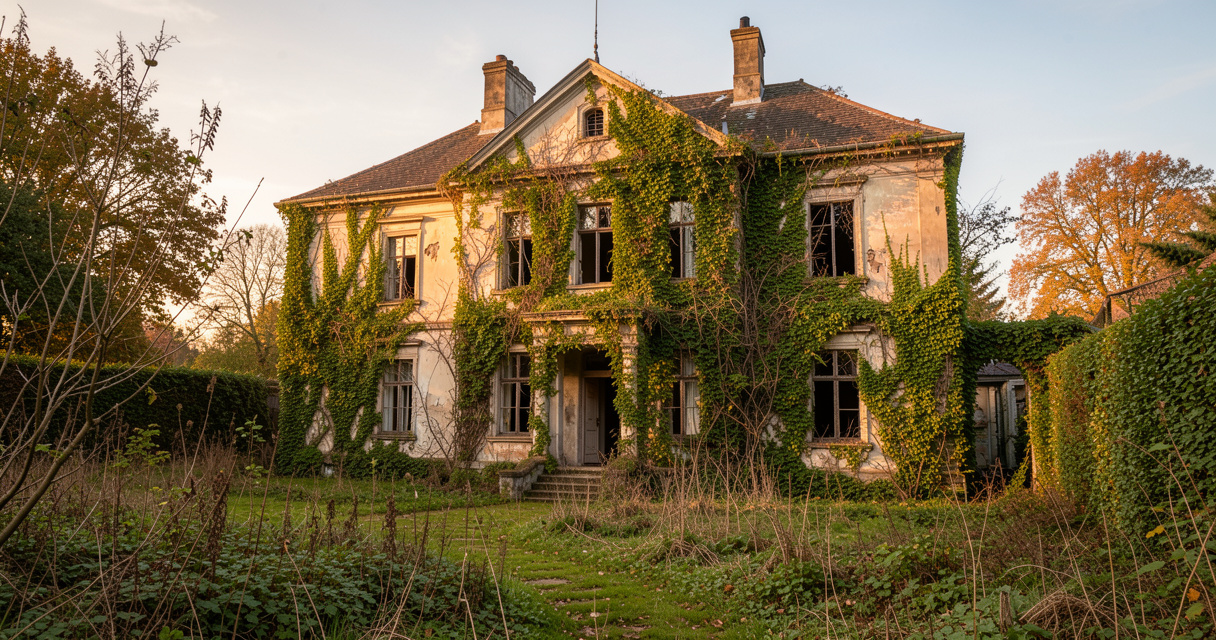
Reading time: 20 min
Table of Contents
- Key takeaways
- What Counts as an Abandoned Mansion for Sale?
- Abandoned vs. Vacant vs. Unfinished
- Why Buyers Are Drawn to Historic Ruins
- Where to Find Abandoned Mansions for Sale
- National Listing Platforms
- Local Auctions and Preservation Groups
- How to Verify a Listing
- How Much Do Abandoned Mansions Cost?
- The $1.3 Million Oregon Example
- Cheap Rural Listings and Their Trade-Offs
- Land Value vs. Building Value
- Restoration Costs: The Real Budget Behind a Cheap Mansion
- Structural and Mechanical Systems
- Permits, Inspections, and Historic Rules
- A Realistic Cost Stack
- How to Buy an Abandoned Mansion Safely
- Title, Liens, and Ownership
- Inspection and Contractor Walkthrough
- Financing and Insurance
- Closing Checklist
- Unfinished vs. Historic Abandoned Mansions
- Unfinished Shells
- Historic Estates
- Decision Matrix
- State-by-State Snapshot: Georgia, Oregon, Montana, and More
- Pacific Northwest
- Mountain West
- South and Midwest
- Common Red Flags and Final Buyer Checklist
- Top Red Flags
- Go/No-Go Checklist
- Frequently asked questions
- The Verdict Before You Sign
Key takeaways
- Verified listings beat beautiful galleries. A 9,052-square-foot mansion in Tigard, Oregon, was listed at $1.3 million in 2024 with no electricity, water, or heating — proof that abandoned mansions for sale are priced on land and potential, not on habitability.
- Purchase price is the smallest number in the deal. Restoration costs, utility reconnection, permits, historic approvals, and insurance usually exceed the acquisition figure by a wide margin.
- Financing is the real gatekeeper. Most lenders will not touch a property without a certificate of occupancy, which pushes buyers toward cash, bridge loans, or renovation products.
- Walk away when title, access, or structure fails. No facade is worth a contested deed, a missing easement, or a foundation that needs replacing.
A 9,052-square-foot mansion in Tigard, Oregon, has stood empty since 2008. No working electricity. No water. No heating. As of 2024, its asking price was still $1.3 million. That single listing explains why the market for abandoned mansions for sale rewards patience and punishes romance.
The photographs are always beautiful: ivy climbing a limestone portico, a staircase frozen mid-collapse, late light falling through a broken window. What the galleries rarely show is the second number — the one covering restoration costs, title defects, and the price of simply making the building habitable again. Every abandoned mansion is a legal entity before it is an aesthetic object, and the buyers who succeed are the ones who read the deed before they read the mood board.
This edit is built for the reader who wants both numbers before making an offer. We will look at real, named listings — Tigard, Oregon; Cromwell Island, Montana; the hundred-year-old inventory surfacing on Zillow filters — and then at the machinery beneath them: title searches, structural inspections, zoning permits, squatters, insurance, and the brutal arithmetic of historic preservation.
The discerning buyer knows that a cheap mansion is rarely a cheap purchase. Worth every mile of the drive to see it in person — in the rain, preferably, when the roof tells the truth.
What Counts as an Abandoned Mansion for Sale?
An abandoned mansion is a property left without occupants and without maintenance, usually for years, while its legal status remains entirely ordinary: someone still owns it, still owes taxes on it, and can still sell it. That is the first thing buyers misunderstand. Abandonment is a condition, not a legal category. The deed does not know the roof is failing.
For scale, consider the benchmark used in 2024 by Business Insider, which reviewed four abandoned or unfinished mansions, each offering at least 4,000 square feet of interior space. That threshold is a useful editorial filter: below 4,000 square feet you are generally looking at a large old house, not a mansion, and the economics of restoration change accordingly.
Abandoned vs. Vacant vs. Unfinished
The vocabulary determines your financing, your insurance, and your timetable. A vacant mansion is empty but typically maintained: utilities may still be connected, insurance is obtainable, and a lender can treat it as a normal asset. A distressed property is a market term — the price already reflects condition, and the seller wants speed.
An unfinished mansion is a different animal altogether. It may never have received a certificate of occupancy, may never have had permanent utilities, and may carry partially permitted work that no inspector has ever signed off on. An abandoned mansion sits at the intersection: no occupants, severed services, deferred maintenance, and a title that is usually clean but occasionally anything but.
Definitions that matter at the closing table
- Abandoned mansion: no occupants, no maintenance, services often disconnected, owner still legally responsible.
- Vacant mansion: empty but maintained, usually insurable and financeable.
- Distressed property: a pricing category, often short-sale, foreclosure, or estate-driven.
- Unfinished mansion: construction halted before completion, frequently without occupancy permits.
The Tigard example fits the pattern precisely. Construction began in 2006 and was never finished; the property has been abandoned since 2008, after the builder ran into building-loan complications during the recession, according to Business Insider, citing The Oregonian. Twenty years of weather, no heat, no water, and a partially completed envelope — that is what $1.3 million buys in suburban Portland.
Why Buyers Are Drawn to Historic Ruins
Because scarcity is the only thing luxury cannot manufacture. You can build a new estate in almost any market; you cannot rebuild a 1904 limestone staircase, a hand-carved newel post, or a ballroom with sixteen-foot ceilings. Historic abandoned mansions for sale offer something the new-build market cannot: provenance.
There is also the land argument. The Tigard property sits on a 1.5-acre lot that can be split into seven buildable lots. A buyer is not only purchasing a wreck; they are purchasing entitlement upside, which is precisely why the asking price has held while the house has not.
Understanding what these properties actually are leads directly to the harder question: where they surface, and how to tell a live listing from a Pinterest ghost.
SECTION_IMAGE_1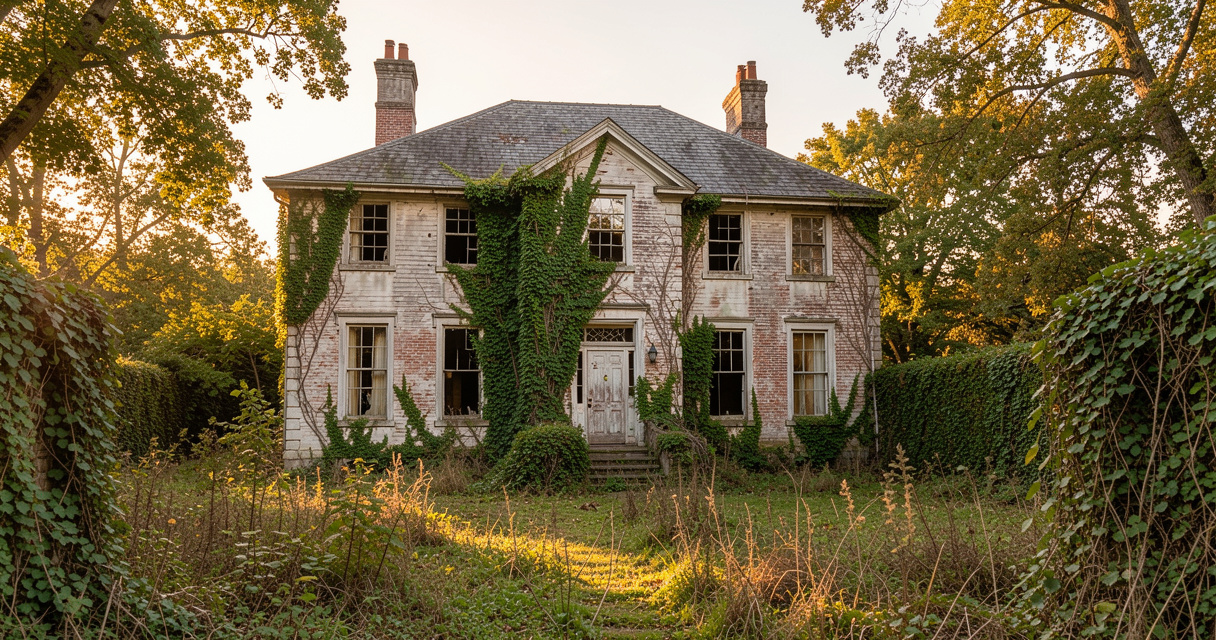
Where to Find Abandoned Mansions for Sale
Old abandoned houses for sale do not live in one place. They surface across national portals, local auction houses, preservation nonprofits, county clerk records, and — increasingly — social accounts that aggregate derelict listings for an audience that will never buy one. The search strategy has to match the source.
National Listing Platforms
Cheap Old Houses has done more for this niche than any brokerage: its audience treats a $79,000 Victorian in upstate New York as a cultural artifact. Old Houses USA and Realportico catalogue older inventory with European reach. Zillow remains the volume play — a New York search filtered to buildings around a century old returned 74 homes matching the criteria, which tells you how deep the inventory runs once you stop searching for the word “abandoned.”
That is the insider detail most buyers miss: nobody lists a property as “abandoned.” Search by year built, days on market, acreage, and price reduced. Those four filters will surface more genuine candidates than any keyword.
Local Auctions and Preservation Groups
County tax auctions are where the genuinely cheap stock appears — and where the genuinely dangerous stock appears alongside it. Tax sales can transfer a property with existing liens, redemption periods, or occupants who hold legal rights. Preservation societies and Main Street programs in Savannah, Natchez, and the Hudson Valley often maintain informal lists of at-risk properties whose owners are quietly willing to sell.
For anyone searching “abandoned mansion for sale near me,” the practical route is a radius search on a national portal, cross-referenced against the county assessor’s parcel map. The assessor’s office is free, unglamorous, and more accurate than any aggregator. The kind of due diligence that separates a restoration from a ruin starts there.
How to Verify a Listing
Social media is where listings go to die. A photograph posted in 2019 may depict a house demolished in 2022. Before any site visit, confirm four things: that the parcel number matches the address, that the owner on the deed matches the seller, that taxes are current or the arrears are quantified, and that the property is not already under contract.
| Source type | Best for | Typical weakness | Verification step |
|---|---|---|---|
| National portals (Zillow, Realtor) | Volume and price history | Rarely flags condition honestly | Cross-check parcel number with county assessor |
| Niche platforms (Cheap Old Houses, Old Houses USA, Realportico) | Editorial curation, historic stock | Listings can be stale or already sold | Call the listing agent for current status |
| County tax auctions | Genuinely low entry prices | Liens, redemption periods, occupants | Order a full title search before bidding |
| Preservation groups | Off-market, motivated owners | Informal, unverified data | Request deed and tax records directly |
| Social media and Pinterest | Discovery and inspiration | No price, no status, no title detail | Treat as a lead only, never as a listing |
Once a listing survives verification, the conversation moves to money — and the numbers are stranger than most buyers expect.
SECTION_IMAGE_2How Much Do Abandoned Mansions Cost?
Abandoned mansion prices depend on location, land value, and condition. In 2024, a 9,052-square-foot seven-bedroom mansion in Tigard, Oregon, was listed at $1.3 million despite lacking electricity, water, and heating. Cheap rural listings can be far lower, but buyers should budget for cash purchase, title checks, and major restoration.
The $1.3 Million Oregon Example
Read that figure again. A mansion with no power, no plumbing, and no heat, unfinished since 2008, asking seven figures. The explanation is not delusion; it is arithmetic. The structure sits on 1.5 acres zoned for up to seven buildable lots in a metro area where land is the scarce asset. The house is almost incidental.
According to Business Insider, citing The Oregonian and The Wall Street Journal, the Tigard mansion has been abandoned since 2008 and remained listed at $1.3 million in 2024 — a case study in land value outrunning building value.
This is the single most useful lesson in the entire category. When an abandoned mansion is priced high, you are usually buying dirt with a story attached. When it is priced low, you are usually buying a liability with dirt attached. Either way, the house is not the asset.
Cheap Rural Listings and Their Trade-Offs
Then there is the other end of the market: abandoned mansions for sale cheap, in the $30,000 to $150,000 band, usually in the rural South, the Rust Belt, or the Great Plains. These listings are real. They are also frequently cash-only, sold as-is, with the utilities long since severed and the roof at the end of its service life.
A low price in this tier usually encodes one of four things: structural failure, environmental contamination, an unresolvable title issue, or a location with no resale market at all. Occasionally it encodes all four. The buyer who assumes a $60,000 mansion plus $400,000 of work beats a $900,000 turnkey house is running a spreadsheet that rarely survives contact with a contractor.
| Price tier | Typical condition | Common location | Buyer requirement |
|---|---|---|---|
| Under $100,000 | Roof failure, no utilities, possible collapse | Rural South, Midwest, Plains | Cash, demolition contingency, high risk tolerance |
| $100,000–$300,000 | Structurally sound shell, systems obsolete | Small cities, historic districts | Cash or renovation loan, contractor lined up |
| $300,000–$800,000 | Partial restoration, permits partially in place | Secondary metro markets | Bridge or renovation financing, preservation review |
| $800,000–$1.5 million+ | Unfinished or derelict, strong land value | Coastal, mountain, high-growth metros | Cash or portfolio lender, entitlement strategy |
Land Value vs. Building Value
Every abandoned mansion should be appraised twice: once as a building, once as a parcel. If the building value is negative — that is, if demolition and disposal cost more than the structure contributes — you are a land buyer, and you should negotiate accordingly, including the cost of asbestos abatement and debris removal before you sign.
Warning: the list price is the smallest number in the file
A low asking price can conceal demolition costs, municipal liens, years of unpaid taxes, utility reconnection fees, code enforcement fines, and legal costs to remove occupants. Always request a lien certificate and a tax history before making an offer.
And once the purchase price is settled, the real budget begins — the one that decides whether the project is a restoration or a slow liquidation.
Restoration Costs: The Real Budget Behind a Cheap Mansion
Here is the honest framing: on a derelict mansion, restoration costs almost always exceed the purchase price, often by a multiple. The Tigard property is the cleanest illustration available. It has no electricity, no water, and no heating — meaning every mechanical system must be designed and installed from scratch, permitted, and inspected, in a building that was never finished.
That is not a renovation. That is construction.
Structural and Mechanical Systems
Start at the roof and work downward, because water is the only contractor that never sends an invoice until the end. A failed roof on a 9,000-square-foot footprint is a five-figure expense before any interior work begins, and the damage it has already done — to sheathing, joists, plaster, and flooring — is where budgets turn savage.
Then the invisible systems: electrical service and panel, plumbing supply and waste, HVAC, well and septic if rural, and fire suppression if the property is large enough to require it. In an abandoned mansion, assume all of it is absent rather than merely outdated. Assume asbestos in pipe wrap and floor tile, lead paint on every pre-1978 surface, and mold in every wall that has been wet for a decade.
Permits, Inspections, and Historic Rules
Permitting is where the timeline lives. Unpermitted work left by a previous owner must often be legalized, which may mean opening walls for inspection. In a historic district, exterior changes require design review — windows, roofing material, and even paint color can be regulated. Those approvals add months, and months add interest.
The offset is the historic preservation tax credit, which in many states and at the federal level can recover a meaningful share of qualified rehabilitation spending. It is also slow, technical, and administered by people who care deeply about mortar composition. Budget for a preservation consultant; it is the cheapest line item in the file.
| Cost category | Typical scope | Why abandoned mansions cost more | Budget caution |
|---|---|---|---|
| Roof and envelope | Full replacement, flashing, gutters | Years of undetected water intrusion | Assume structural repair beneath |
| Foundation and framing | Underpinning, sill replacement, joist repair | No heating means freeze-thaw damage | Requires engineer, not inspector |
| Electrical and plumbing | Complete new service and distribution | Services often severed at the street | Include utility reconnection fees |
| HVAC | New system, ductwork, insulation | Nothing exists to retrofit | Historic districts may restrict equipment |
| Hazard abatement | Asbestos, lead paint, mold | Decades of unchecked deterioration | Licensed contractors only |
| Permits and design review | Building, zoning, historic approvals | Unpermitted legacy work must be legalized | Timeline risk equals interest cost |
| Contingency | 15–25 percent of total | Unknowns are the defining feature | Do not treat this as optional |
A Realistic Cost Stack
Walk the Tigard shell in your mind. Nine thousand square feet, seven bedrooms, no doors, no heat, no water, no power. Every room is a line item. Every line item has a permit attached. Every permit has a review period. The restoration on a property of that scale, brought to a modern standard, is a multi-million-dollar proposition — which is exactly why it sat unsold.
I have walked enough of these buildings to know the moment the arithmetic lands. You stand in a grand entry hall with water staining the ceiling medallion, and you realise the medallion alone costs more to restore than the entire landscaping budget of a normal house. “Everyone falls in love on the driveway,” a preservation contractor in the Hudson Valley told me. “The ones who close are the ones who fall out of love in the basement.”
Which is why the next section is the one that actually protects you.
How to Buy an Abandoned Mansion Safely
Buying an abandoned mansion is a sequence, not a decision. Each step can end the process, and the earlier it ends, the cheaper the education. Work through the following in order — do not let enthusiasm reorder it.
Title, Liens, and Ownership
Order a full title search before anything else. It will tell you who actually owns the property, whether the deed is valid, and what encumbrances attach to it: mortgages, mechanics’ liens, municipal code liens, easements, and judgments. In estate situations, confirm that every heir with an interest has signed. Heirs who surface after closing are the most expensive kind of surprise.
Then check taxes at the county level and confirm access. A parcel without legal access — no easement, no frontage — is landlocked and effectively unsellable, regardless of the house on it.
Inspection and Contractor Walkthrough
A standard home inspection is not sufficient. You need a structural engineer for foundation and framing, an environmental assessment for asbestos, lead, mold, and any underground tanks, and a general contractor who will walk the property with you and give a rough order-of-magnitude number. That contractor conversation is worth more than any report.
If the property sits in a historic district, add a review of the local design guidelines and the secretary of the interior’s standards. What you may change, and how, will shape both the budget and the timeline.
Financing and Insurance
Can you get a mortgage on an abandoned mansion? Usually not. Conventional lenders require the property to be habitable, insured, and in marketable condition. Without utilities or a certificate of occupancy, most will decline. The realistic routes are cash, a renovation or 203(k)-style loan where eligible, a bridge loan, or a specialist lender accustomed to historic assets.
Insurance is the parallel problem. Standard homeowner policies will not cover a vacant or derelict structure; you need vacant-property or builder’s-risk coverage, which costs more and covers less. Secure a quote before removing contingencies — an uninsurable property is an unfinanceable property.
Closing Checklist
Also assess occupancy. If anyone is living in the property — a tenant, a holdover relative, or squatters — removal is a legal process, not a phone call. In many jurisdictions it takes months and requires counsel. Establish in writing who bears that cost and responsibility.
- Title search complete, no unresolved liens or heir claims
- Tax status confirmed and arrears quantified
- Zoning and permitted use verified for your intended plan
- Legal access and easements confirmed in writing
- Structural engineer’s report obtained
- Environmental assessment completed
- Utility reconnection costs quoted by the provider
- Contractor’s rough budget and timeline in hand
- Insurance quote secured for vacant or builder’s-risk cover
- Financing pre-approved, with cash reserve documented
- Occupancy status resolved and documented
- Contingency clauses written into the contract
Do not rely on a standard home inspection alone. Order structural, environmental, and historic-district reviews separately, and keep every contingency in writing until all three are answered.
Once the diligence is done, the strategic question remains: which kind of impossible property do you actually want?
Unfinished vs. Historic Abandoned Mansions
These are two different businesses wearing the same coat. Unfinished mansions for sale offer a blank interior inside a possibly compromised shell. Historic estates offer character inside a structure that has already proven it can stand for a century — but which comes with regulations, specialized trades, and approvals.
Unfinished Shells
The Cromwell Island estate in Montana’s Flathead Lake is the definitive example: a 45,000-square-foot mansion begun in the late 1990s and never finished, according to Business Insider. Scale like that does not merely fail — it fails spectacularly, because every incomplete system is multiplied by 45,000 square feet of expectation.
The advantage of an unfinished shell is that nothing needs to be sensitively removed. You are not stripping horsehair plaster; you are starting from a stud cavity and designing forward. The risk is that the shell itself was never closed properly, and a decade of exposure has compromised what looked solid.
Historic Estates
A historic property has already survived. That is not a small thing: the foundation has settled, the frame has proven itself, and the original detailing exists to be conserved. The trade-off is permission. Window replacements need approval, roofing materials are prescribed, and the tradespeople who can reproduce 1890s millwork are few, booked out, and expensive.
Decision Matrix
| Property type | Main advantage | Main risk | Best buyer profile |
|---|---|---|---|
| Unfinished shell | Free rein on layout and systems | Open envelope has been weathering for years | Builder-developer with in-house construction capacity |
| Historic estate | Proven structure, irreplaceable detail, tax credits | Design review, specialist trades, regulatory delay | Patient owner-occupier with preservation appetite |
| Land-value play | Entitlement and subdivision upside | Demolition cost, abatement, community objection | Developer underwriting the dirt, not the house |
The geography of these opportunities is not uniform, which is why the next section matters more than any national average.
State-by-State Snapshot: Georgia, Oregon, Montana, and More
Abandoned mansions for sale by state are not a single market. They are dozens of local markets with different price signals, different preservation regimes, and different exit liquidity. What follows is a directional map, not a ranking.
Pacific Northwest
Oregon’s story is the Tigard mansion: high land value, unfinished construction, and a seven-figure ask on a building that cannot legally be occupied. In the Pacific Northwest, the land is the deal and the structure is the negotiation.
Mountain West
Montana’s Cromwell Island spans roughly 350 acres with almost three miles of shoreline, per Business Insider — a reminder that in the Mountain West, unfinished luxury scale is often a symptom of capital failure rather than market weakness. Buyers here need patience and a very large balance sheet.
South and Midwest
Georgia draws heavy interest on social platforms, with buyers searching for abandoned mansions for sale in Georgia with acreage. The trade-off is familiar: lower entry prices, longer restoration timelines, thinner contractor markets, and resale values that may never justify the spend. New York offers volume instead — a Zillow filter for century-old homes returned 74 matches — but with high taxes and aggressive code enforcement.
| State or region | Verified example | Price signal | Local buyer caution |
|---|---|---|---|
| Oregon | 9,052 sq ft Tigard mansion, abandoned since 2008 | $1.3 million (2024), land-driven | No utilities; entitlement strategy required |
| Montana | 45,000 sq ft Cromwell Island estate, never finished | Ultra-prime, shoreline-driven | Remote logistics; enormous scale risk |
| Georgia | High social-platform interest, acreage searches | Low to mid entry prices | Thin contractor pool; slower resale |
| New York | 74 century-old homes in one filtered search | Wide spread by county | High taxes; strict code enforcement |
| Midwest | Scattered rural inventory | Lowest tiers | Demolition may be the only rational exit |
Across all of these markets, the same warning signs recur — and they are the ones that end projects before they begin.
Common Red Flags and Final Buyer Checklist
Most failed purchases share one of eight symptoms. Treat any single one as a reason to pause, and any combination as a reason to walk.
Top Red Flags
- Unclear or contested title, or heirs who have not all signed
- Active occupants with potential legal rights
- Utilities severed at the street with no reconnection quote
- Structural collapse risk or foundation failure
- Extensive unpermitted work requiring legalization
- Environmental hazards: asbestos, lead, mold, underground tanks
- Flood-zone exposure with uninsurable risk
- Restoration estimates that assume a turnkey outcome
Go/No-Go Checklist
- Title: clean, insurable, all interest holders signed — pass or fail
- Access: legal, documented, year-round — pass or fail
- Structure: engineer confirms the frame is repairable within budget — pass or fail
- Utilities: reconnection costed and feasible — pass or fail
- Permits: intended scope approvable — pass or fail
- Insurance: quote in hand — pass or fail
- Financing: committed, with contingency — pass or fail
- Exit: resale or rental case modelled on the finished asset — pass or fail
Two fails and you are not buying a mansion. You are buying a hobby.
Frequently asked questions
Are abandoned mansions for sale cheap?
Some rural listings are inexpensive, but the price usually reflects severe condition, land value, or cash-only terms. A verified 2024 example in Tigard, Oregon, was listed at $1.3 million despite lacking electricity, water, and heating.
Can you legally buy an abandoned mansion?
Yes, provided ownership is confirmed through a title search, lien check, tax review, and zoning review. Buyers should also confirm access rights and whether any occupants hold legal claims.
How much does it cost to restore an abandoned mansion?
It ranges from major cosmetic work to full structural, mechanical, and utility replacement. Because these properties require permits, historic approvals, and specialist trades, the total typically exceeds the purchase price by a substantial margin.
Are abandoned mansions a good investment?
They can be, but only when acquisition price, restoration budget, financing cost, and resale or rental exit are modelled together. The cheapest property is rarely the best investment if it demands demolition or years of legal work.
Can you get a mortgage on an abandoned mansion?
Many lenders will not finance a property that is uninhabitable or lacks utilities. Buyers typically need cash, a renovation loan, a bridge loan, or a specialist historic-property lender.
Where are abandoned mansions for sale in the US?
Listings appear nationwide, with notable examples in Oregon, Montana, Georgia, New York, and the Midwest. National platforms, local auctions, preservation groups, and county records are the most reliable starting points.
What should I check before buying an abandoned mansion?
Check title, liens, taxes, zoning, access, structural condition, utilities, environmental hazards, permits, insurance, and financing. A contractor walkthrough and historic-district review are essential before removing contingencies.
The Verdict Before You Sign
The edit, then, is unromantic and necessary. Verify title, liens, zoning, access, and occupancy before you fall in love with a facade. Budget for restoration, utilities, permits, insurance, and financing — not just the list price. Compare unfinished shells with historic estates, and choose the risk profile you can genuinely manage rather than the one that photographs best.
And keep the right people around you: a local contractor who has worked in that county, a preservation consultant who knows the review board, and a real estate attorney who reads deeds for a living. None of them will tell you what you want to hear. All of them will save you six figures.
Abandoned mansion listings will always be more beautiful than they are sensible. That is the entire appeal, and it is also the entire trap. The buyers who win are the ones who can hold both truths at once — who can see the staircase and the sewer line in the same glance, and who know which one sets the budget.
So before you fall for a crumbling facade, ask yourself one question: are you buying a home, a restoration project, or simply the land underneath it? Answer that before you answer anything else.